


Prestashop, Magento, WooCommerce, Wix, Squarespace, Shopify: you've been comparing e-commerce platforms for hours and are no further along. The feature comparison tables all look the same. Yet, there's a huge difference between a platform that generates revenue and one that wears you out. This article is not intended to be universal. It addresses a specific profile: ambitious brands that want to make e-commerce a real growth driver, without draining their resources. This has been the approach of our Shopify agency since 2018. Comparison updated in 2026.
In summary: for a brand that wants to sell without managing the technical aspects, Shopify is the clear choice in 2026. PrestaShop and Magento remain reserved for pure players with a technical team, WooCommerce for existing WordPress sites, and Wix and Squarespace for small projects or showcase sites with a supplementary store. We'll explain why below.
Table of Contents
This comparison is for you if...
There are dozens of Shopify vs Prestashop vs Magento vs WooCommerce comparisons. Most mechanically list features without ever considering who actually manages the store daily. The reality on the ground, after years of supporting brands on Shopify, is much more nuanced.
This guide starts from a specific client profile. You are a brand with an established reputation or an ambition for rapid growth. You have measurable digital objectives. And most importantly, you don't have an in-house developer or technical expert. If you recognize yourself in this description, the criteria that really matter come down to three: the ability to sell, ease of daily use, and real cost.
If you are in the opposite situation, if you have an in-house technical team and generate several million euros in online revenue, Magento remains a relevant solution. This comparison is not for you.
The three real selection criteria
Ability to sell
Your online store is not an IT project. It's a sales channel. The platform you choose must therefore deliver on three concrete dimensions: technical reliability (does the site hold up during traffic peaks?), the quality of the purchasing funnel (how many visitors abandon before paying?), and the ability to conduct marketing operations quickly.
The figures on shopping cart abandonment speak for themselves. According to research by the Baymard Institute, 70.19% of carts are abandoned before purchase. Among the reasons cited: unexpected additional costs (48%), the obligation to create an account (26%), and a lack of trust in the site (25%). The same institution states that a better checkout experience could increase conversion rates by an average of 35%. This is not a technical detail: it is the core of your revenue at stake.
Daily use
E-commerce is a reactive business. Changing a banner, launching a flash promotion, testing a new app: you can't wait for an agency's schedule for every routine operation. The question isn't "can the platform do this?" but "can I do it myself, without calling anyone?"
Real cost
The cost of an e-commerce platform is not limited to its license price. You must include the initial development cost, recurring costs (hosting, maintenance, updates), costs for third-party modules or applications, and the internal time you dedicate to it. A marketing manager who spends 30% of their time managing bugs is 30% of the marketing budget wasted.
The golden rule: invest in marketing and advertising, not in technical commodities. Any amount spent on maintenance is an amount that does not generate revenue.
Comparison table of the 6 platforms in 2026
Here is an overview of the six most common e-commerce platforms in 2026. The prices indicated are the entry-level rates for selling online, excluding hosting for open-source solutions.
| Platform | Type | Starting Price (2026) | Ease of Use | Ideal for |
|---|---|---|---|---|
| Shopify | Hosted SaaS | €25/month (Basic) | Very High | Brands that want to sell without managing technical aspects |
| WooCommerce | Self-hosted WordPress extension | Free + hosting | Medium | Existing WordPress sites, small budgets |
| PrestaShop | Self-hosted Open Source | Free + hosting | Low | Pure players with a technical team |
| Magento (Adobe Commerce) | Self-hosted Open Source | Free to very high | Low | Large catalogs and large enterprises |
| Wix | SaaS website builder | $29/month (Core) | Very High | Small sites and showcases with some selling |
| Squarespace | SaaS website builder | $23/month (Core) | High | Design-focused and creative sites, small e-commerce |
This table provides a general direction, but each platform needs to be understood in its context. Here's a detailed analysis, platform by platform.
WooCommerce: the illusion of lower cost
WooCommerce is a WordPress plugin. It is not an e-commerce platform in its own right: it is a commercial layer added to a CMS designed for blogging. This distinction is fundamental.
Up to a certain volume, WooCommerce works. But as soon as you scale up, the platform's structural limitations appear. Traffic spikes can take your site offline, meaning hours, or even days, of lost revenue. The accumulation of plugins to compensate for missing features creates permanent conflicts during WordPress updates. And the increase in catalog or customer base generates progressive slowdowns that are difficult to resolve without technical expertise.
If you already have a WordPress showcase site and are considering WooCommerce to transition to e-commerce at a lower cost, it may seem like a logical short-term decision. In the medium term, you will face unforeseen technical investments that will render this initial saving obsolete. If you want e-commerce to be a serious channel, choose a platform designed for it from the start.
The right use case: WooCommerce remains relevant if you already have a high-traffic WordPress blog, a small catalog, and real technical proficiency in-house. For more in-depth information, consult our detailed Shopify vs WooCommerce comparison.
PrestaShop and Magento: powerful, but at what price?
PrestaShop and Magento share the same philosophy: they are open-source software to be downloaded and hosted on your own infrastructure. Technically robust, designed for scalability, supported by serious publishers. On paper, it ticks all the boxes. In practice, it's another story for the brand profile described above.
The question of ergonomics: the breaking point
The main reason brands leave PrestaShop or Magento for Shopify is not technical. It's the daily experience. Marketing managers who handle e-commerce in addition to their other duties have neither the time nor the desire to train themselves on back-offices designed for developers. Magento, in particular, is complex software, with an interface inherited from the Windows software era: menus, sub-menus, nested tabs, priority given to function over usability.
The time spent resolving bugs related to custom developments, tracking updates, coordinating service providers—this is time stolen from marketing. This is the structural problem of these platforms for a profile without in-house technical expertise.
The real cost of Magento and PrestaShop
Both software are free and open source. But this free aspect is misleading. You have to factor in the initial development cost (significantly higher than on Shopify for equivalent functionalities, especially on Magento), the purchase of third-party extensions (between €100 and several hundred euros per module, without the possibility of testing them before purchase), high-performance hosting with at least a production and a pre-production environment, and a recurring maintenance contract with a service provider.
These two solutions remain relevant in two specific cases: you are a pure player with in-house Magento or PrestaShop developers, or you generate enough revenue that the cost of technical outsourcing is negligible.

The Magento admin panel

The PrestaShop admin panel
For brands looking to migrate from PrestaShop, our guide our complete PrestaShop vs Shopify showdown details the concrete benefits of this transition.
Wix: the general public website builder
Wix is an all-in-one SaaS website builder, designed primarily for showcase sites, portfolios, and small businesses. Its promise: to create a beautiful and functional site yourself without any technical skills, thanks to one of the most intuitive drag-and-drop visual editors on the market. Over the years, Wix has added an e-commerce module, making it an option for brands that want to sell a few products as an adjunct to a primary activity.
Wix's strengths
It's immediately user-friendly, and the editor offers almost total layout freedom, which few platforms provide. The app ecosystem (Wix App Market) covers common needs, and maintenance is entirely managed by Wix. For a showcase site with a supplementary shop, it's quick to launch and hassle-free.
Wix's limitations for an e-commerce brand
Wix shows its limits as soon as sales become the core business. The e-commerce engine remains less in-depth than Shopify's: catalog management, marketing automations, reporting, and the purchasing funnel are adequate for small volumes but cannot compare in terms of conversion and scalability. Design freedom also has a downside: a poorly constructed site quickly becomes heavy, which impacts mobile performance and SEO. Finally, migrating a Wix site is not easy: the ecosystem is closed.
Wix pricing in 2026
Wix offers four paid plans: Light at approximately $17/month (no e-commerce), Core at approximately $29/month (first e-commerce level), Business at approximately $39/month, and Business Elite at approximately $159/month. Wix does not charge commissions on sales beyond payment provider fees (around 2.9% plus $0.30 per transaction). To sell, you need at least the Core plan.
The right use case: Wix is suitable for an artisan, creator, or service business that wants a beautiful showcase site and to sell a few products, without ambition to scale. As soon as e-commerce becomes the main activity, a dedicated platform is necessary. Brands that want to step up their game will find the way forward in our guides to migrating to Shopify.
Squarespace: design first
Squarespace is the other major SaaS website builder, renowned for the quality of its templates and its refined aesthetic. Where Wix emphasizes total layout freedom, Squarespace imposes well-designed templates that guarantee an elegant and consistent look, even without a designer's eye. It is the preferred choice for creatives, photographers, lifestyle brands, and businesses where image is paramount.
Squarespace's strengths
The visual rendering is high-end by default, mobile consistency is excellent, and the whole remains simple to administer. Squarespace natively integrates blogging, portfolios, appointment booking, and a decent e-commerce module for small catalogs. For a brand that sells a story and an aesthetic as much as a product, it is a favorable environment.
Squarespace's limitations for scaling
Like Wix, Squarespace reaches its limits when e-commerce becomes central. The app ecosystem is more restricted, marketing automations and conversion features (retargeting, segmentation, optimized funnel) are less advanced than on Shopify, and deep customization remains constrained by templates. This is a deliberate compromise: you gain simplicity and aesthetics, you lose commercial power.
Squarespace pricing in 2026
Squarespace offers four plans: Basic around $16/month, Core around $23/month (e-commerce with a commission of about 3%), Plus around $39/month (no sales commission), and Advanced around $99/month (subscriptions, advanced shipping). To sell seriously without commission, you need to aim for the Plus plan.
The right use case: Squarespace is ideal for a creative brand, a studio, or a niche business that wants a beautiful site and a simple shop. For a large sales volume and an aggressive acquisition strategy, the platform quickly becomes limiting.
Shopify: why the platform is dominant in 2026
Shopify is a hosted SaaS solution. This fundamentally changes the equation compared to PrestaShop and Magento: you're not buying software, you're renting a complete infrastructure. The nuance is essential.
Unmatched reliability at scale
Shopify is both a publisher and a host. This allows it to guarantee unlimited bandwidth, permanent availability, automatic security updates, and a global CDN. During Black Friday Cyber Monday 2025, Shopify merchants achieved a record $14.6 billion in sales, up 27% year-over-year, with a peak of $5.1 million in sales per minute. More than 81 million consumers purchased from a Shopify-powered brand during that single weekend. This is an infrastructure that few independent hosts can match for an equivalent cost.
In 2026, Shopify accounts for about 10% of the global e-commerce market share and nearly 29% in the United States, with nearly 3 million active stores. This critical mass is not insignificant: it constantly fuels optimizations in the purchase funnel, checkout, and mobile performance.
Checkout: the decisive competitive advantage
The Shopify checkout is common to all stores on the platform. It is the result of millions of hours of A/B testing on hundreds of thousands of sites. According to Shopify, its checkout converts up to 36% better than its competitors, with an average improvement of 15%. Shop Pay, the native accelerated payment solution used by over 100 million buyers, can by itself increase conversions at the bottom of the funnel by more than 50% when offered.
This is a structural advantage that neither PrestaShop, Magento, WooCommerce, Wix, nor Squarespace can offer by default: from day one, you benefit from a purchase funnel optimized by data from millions of transactions.
Daily autonomy
Shopify is designed so that marketing teams can work without depending on a developer. Changing a banner, creating a promotion, installing a new app (and testing it for 7 to 14 days before any commitment): all of this is done from an interface as intuitive as the best mobile applications. The concrete result: your teams spend their time on marketing, not on maintenance.
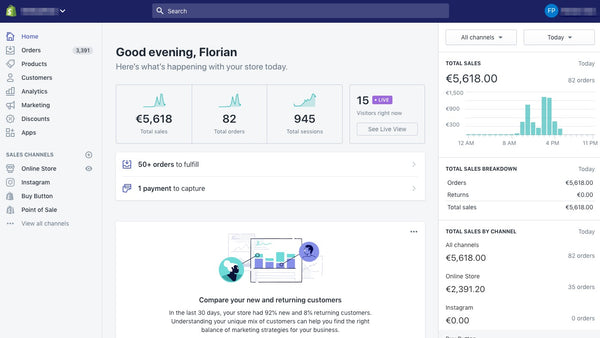
The home page of your Shopify store's admin
Apps from the Shopify store are natively compatible with the platform. No external intervention is needed to test them, no risk of conflict with a WordPress update or a Magento extension. This is a radically different philosophy from the open-source ecosystem. Consult our guide to the 10 essential Shopify apps for your store to discover the extensions that truly make a difference.
Shopify plans in 2026
Shopify's pricing structure has evolved. In April 2025, the intermediate plan was renamed Grow, a positioning assumed around growth. Here are the current plans (monthly rates without annual commitment):
- Basic: €36/month monthly, or €25/month annually. Commission on revenue if you don't use Shopify Payments: 2%. Ideal for getting started.
- Grow: €105/month or €66/month annually. Commission: 1%. 5 staff accounts, standard reports. The reference plan for an actively growing brand.
- Advanced: €384/month or €289/month annually. Commission: 0.6%. 15 staff accounts, advanced reports, real-time calculated shipping costs. For high-volume businesses.
- Shopify Plus: starting from €2,100/month. For brands exceeding $2M/year, with B2B, multi-store, or advanced automation needs.
An annual commitment gives a 25% discount on Basic, Grow, and Advanced plans. For equivalent features, this calculation often makes Shopify less expensive than Magento or PrestaShop once all costs are considered. For apps, most offer a free trial of 7 to 14 days, and monthly subscriptions generally range from $7 to $50, with much better ROI visibility than the firm purchase of a PrestaShop module.
The true cost of each platform
Comparing licenses is not enough. The total cost of ownership (TCO) is the only relevant indicator for a strategic decision. Here's how it breaks down for the brand profile described in this article.
Shopify, Wix, and Squarespace: the controlled cost of SaaS
For the three SaaS solutions, hosting, security, and updates are included in the subscription. The difference lies in commercial power. With comparable features, a Shopify store generally costs between €3,000 and €25,000 depending on the level of customization, and apps can be managed month-to-month with visibility on their return on investment. Wix and Squarespace cost less in subscription, but quickly hit a ceiling: beyond a certain volume, their commercial limitations cost lost sales what they save in subscription.
The approach we recommend to our clients is iterative: start with a Shopify store theme, customized and well-configured, then reinvest the budget not spent on technical costs into marketing and advertising. This is how you create growth momentum, not by trying to optimize everything before you even have traffic.
PrestaShop and Magento: the hidden cost of open source
Development cost is higher for equivalent features, especially on Magento. You need to fund high-performance hosting (at least two servers: production and pre-production), a recurring maintenance contract, and modules purchased without the possibility of prior testing. Dependence on your technical provider is strong. Every operation not managed in-house has a cost.
For brands looking to explore all migration options, our Shopify migration guide covers over 70 source platforms.
Our migrations to Shopify: what our experience shows
Beyond the comparison, here's what hundreds of migrations have taught us, which goes against a common misconception: the original CMS has little impact on the complexity of a migration. As long as the data (customer base, order history, product catalog) is stored somewhere and extractable, in CSV or via an API, the transfer happens smoothly. The difficulty does not come from the name of the starting platform, but from the accessibility of the data.
We have verified this on all types of sources. A few concrete examples:
- WooCommerce to Shopify: Caillou Paris, a vintage jewelry house.
- PrestaShop to Shopify: Qiriness, sensorial cosmetics, with journey redesign and Klaviyo CRM.
- Magento to Shopify: Le Petit Olivier (La Phocéenne de Cosmétique group), two Magento sites switched.
- Wix to Shopify: Trèfle Rouge, fashion accessories.
In addition, there have been migrations from Webflow or custom CMS. The pattern repeats: as soon as the data is extractable, the migration is manageable.
Regarding method, we historically used a Matrixify and LitExtension combo. Effective, but the cost can quickly climb when databases are substantial. Today, our integrated AI studio develops private applications with Lovable, connected to Shopify via APIs, to perform custom migrations without depending on a third-party connector billed by volume. Concretely, no matter the type of migration, we know how to do it.
"We entrusted Stellar Projects with the migration of our two Magento sites to Shopify. Thanks to their Shopify and Klaviyo expertise and their 360° support, we were able to make the switch in record time and observed performance improvement at all levels."
Amandine Danulot, E-commerce Manager, Le Petit Olivier (La Phocéenne de Cosmétique group)
One point is particularly close to our hearts: SEO. From experience, we have never observed a drop in rankings after a launch, because the migration is clean and systematically includes the redirection plan. The catalog, customers, and referencing transition from one world to another without interruption. For protocol details, see our Shopify migration guides.
Which platform for which profile?
In summary, here is the most suitable platform according to your situation:
- Ambitious e-commerce brand without a technical team: Shopify. The best performance, autonomy, and cost ratio.
- Pure player with internal developers and a very large catalog: Magento (Adobe Commerce) or PrestaShop.
- Existing WordPress site, small catalog, technical ease: WooCommerce.
- Artisan or service business with an auxiliary shop: Wix.
- Creative or lifestyle brand focusing on design: Squarespace to start, Shopify to scale.
The underlying logic is simple: site builders (Wix, Squarespace) win on the simplicity of a small project, open source (Magento, PrestaShop) wins on total control when you have the technical resources, and Shopify wins on the field that matters for most brands: selling a lot, quickly, without a technical team.
Frequently Asked Questions
Which is the best e-commerce platform in 2026?
For a brand that wants to sell seriously without an internal technical team, Shopify offers the best performance, autonomy, and cost ratio in 2026. Magento and PrestaShop remain relevant for pure players with developers, while Wix and Squarespace are suitable for small projects and showcase sites with an auxiliary shop.
Shopify or WooCommerce: which to choose?
WooCommerce, a WordPress plugin, is suitable for sites that already have a WordPress blog, a small catalog, and technical proficiency. Shopify is essential as soon as e-commerce becomes the core activity, thanks to its reliability, optimized checkout, and daily autonomy. Our dedicated Shopify vs WooCommerce comparison details each point.
Are Wix and Squarespace suitable for e-commerce?
Yes, for small volumes. Wix and Squarespace integrate a decent e-commerce module, ideal for selling a few products alongside a showcase site or creative activity. As soon as selling becomes the main activity and you aim for growth, their limitations in conversion, marketing automation, and scalability push towards a dedicated platform like Shopify.
How much does each platform really cost?
SaaS solutions (Shopify starting from €25/month, Wix starting from $29/month for selling, Squarespace starting from $23/month) include hosting and maintenance. Open-source solutions (PrestaShop, Magento) are free in license but involve hosting, development, and maintenance, which often makes them the most expensive in terms of total cost of ownership for a brand without a technical team.
Can you easily migrate to Shopify?
Yes. The original CMS has little impact on complexity: as long as your data (customers, orders, catalog) can be extracted in CSV or via an API, the migration is done cleanly. We have performed it from WooCommerce, PrestaShop, Magento, Wix, Webflow, or custom CMS, preserving the catalog, customers, and SEO thanks to a systematic redirection plan. Our migration guide covers over 70 source platforms.
Conclusion: Which platform to choose for your brand?
If you've read this article so far, the answer is probably already clear. Shopify is currently the e-commerce platform that offers the best performance, autonomy, and cost ratio for brands that want to make digital a serious sales channel without having an internal technical team.
This is not an opinion: it's what the data confirms. A checkout that converts up to 36% better than the competition, an infrastructure capable of absorbing any traffic peak, an interface that frees your marketing teams from technical constraints, and a cost model that adapts to your growth rather than hindering it.
To go beyond the comparison, discover what Shopify is really worth in 2026 according to our agency experience.
WooCommerce is suitable for simple projects or very constrained budgets. Magento and PrestaShop remain relevant for pure players with in-house technical teams. Wix and Squarespace are excellent site builders for small projects or showcase sites with an auxiliary shop. For all others, the question is not "Shopify or another platform?", but "when do I switch to Shopify?"
At Stellar Projects, we have worked exclusively with Shopify since 2018. Not out of commercial exclusivity: because it is systematically the solution that delivers the best results for our clients. Do you want to evaluate your project? Discover our Shopify creation and migration offer or consult our complete guide to e-commerce platforms to go further.


